

Larisa Alaverdyan: small number of women in Armenian Parliament explained by their passivity
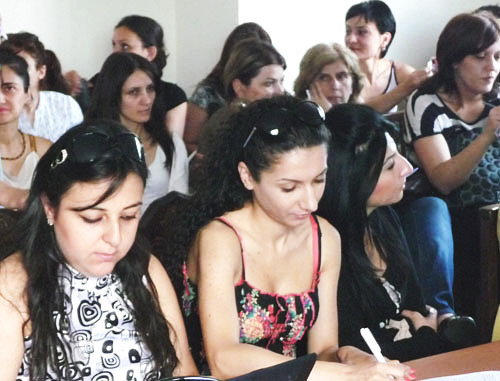
Small number of female deputies in the National Assembly of new convocation can be explained by the passivity of women living in Armenia and the lack of equal conditions. This was stated by Larisa Alaverdyan, an ex-MP of the previous convocation, during the discussion, devoted to the problems of women's participation in the recent parliamentary elections, held on May 6.
The discussion was held in Yerevan, and it was organized by the Armenian office of the British organization "OXFAM", the centre of social science research "Kavkaz", and the cooperation network of the civil society. The event was attended by more than 30 representatives of public organizations and media. Participants of the discussion spoke of participation of female candidates in the electoral process, the principles of their election campaign, the problems of media, and the problems of registered female candidates for deputy, the "Caucasian Knot" correspondent reports.
Margarita Akopyan, Director of the Armenian Office of the British organization "OXFAM", has reminded that in 2011, the Electoral Code of Armenia approved a 20-percent quota for women in the proportional electoral lists.
"However, summarizing the outcome of the recent parliamentary elections, we can see that women represent only 10.7 percent in the Armenian Parliament," she has noted.
"We travel a lot around the regions of the republic, meet women, get to know their problems, and it is painful to admit, how their rights are derogated and how much social inequality of women is seen in civil, social, political, and family relations," she said.
According to her, the countries, in which a larger number of women is represented in the executive branch, pay more attention to social issues and better protect the rights of children, women and vulnerable groups of society.
Astkhik Petrosyan, Director of the centre of social science research "Kavkaz", has emphasized that, in accordance with the study, conducted in November-December 2010, to identify barrier factors of women's participation in politics, the main barriers are presence of criminality in politics, rude struggle, women's dependence on domestic problems, and pre-election bribes.
"The factors that hinder women's participation in politics include women's orientation to families (45.2 percent), lack of women's confidence in their own abilities (35.1 percent), public distrust for female politicians (33.5 percent), lack of mechanisms for women's promotion (29.2 percent), and negative attitudes of relatives (28.3 percent)," she has concluded.
According to Ovannes Ogannisyan, Chairman of the centre "Kavkaz", small number of women in the Parliament of current convocation was also affected by the decisions of the very female candidates. According to his information, after the elections, only 26 women waived their mandates.
"Half of them waived their mandates, since they were offered positions in the executive branch, and the rest waived their mandates for unknown reasons," he stated.
Chairman of the centre believes that the situation is caused by the unimproved election law.
"The law contains no point, stating that only a woman should be nominated for a place of a woman, who had waived her mandate," the expert has noted.
Tamara Ovnatanyan, Chairman of the organization "Promedia-Gender", believes that the women's reluctance to enter politics is directly related to their education.
"If, starting from young age, a woman is being brought up in a direction that she should not be active in civil, social and political life, then, in adulthood, she will have no desire to be engaged in that spheres," she has emphasized.
Source: CK correspondent
![Tumso Abdurakhmanov. Screenshot from video posted by Abu-Saddam Shishani [LIVE] http://www.youtube.com/watch?v=mIR3s7AB0Uw](/system/uploads/article_image/image/0001/18460/main_image_Tumso.jpg "Tumso Abdurakhmanov. Screenshot from video posted by Abu-Saddam Shishani [LIVE] http://www.youtube.com/watch?v=mIR3s7AB0Uw")